
Relay in Industrial Automation: The Business Guide to Hardware Integration

If you run a small manufacturing facility, laboratory, brewery, or logistics warehouse, you have likely encountered a specific technical bottleneck. Your digital control system knows exactly what needs to happen, but it cannot directly power the hardware that performs the work. A sensor detects a temperature spike, or a keypad approves an entry request, but the actual equipment requiring power—a motor, heater, or industrial lock—demands significantly more current than a delicate controller can handle. Implementing a relay in industrial automation is the standard solution to bridge this gap safely and effectively.
A relay in industrial automation acts as an electrically operated switch, permitting a low-power control signal to manage a separate, high-power circuit. For a business owner, this means your software, timers, and AI assistants can trigger substantial physical actions without exposing your sensitive digital components to dangerous electrical loads. This electrical isolation is the cornerstone of modern industrial reliability, protecting your investments from surges and noise while enabling complex machine logic.
How does a relay in industrial automation function in a business?
The fundamental principle of electrical isolation
Think of a relay as a protective gate between two isolated electrical worlds. On one side, you have the control signal—often coming from a computer, PLC, or AI tools. On the other side is the power circuit feeding the equipment. The relay connects these two worlds without allowing them to share the same electrical path. This prevents "inductive kickback" or electrical noise from traveling backward from a heavy industrial motor into your expensive control hardware, which could otherwise lead to system crashes or permanent hardware failure.
Key physical components of the switching mechanism
To manage hardware effectively, you must recognize the four parts that define almost every relay configuration utilized on the shop floor:
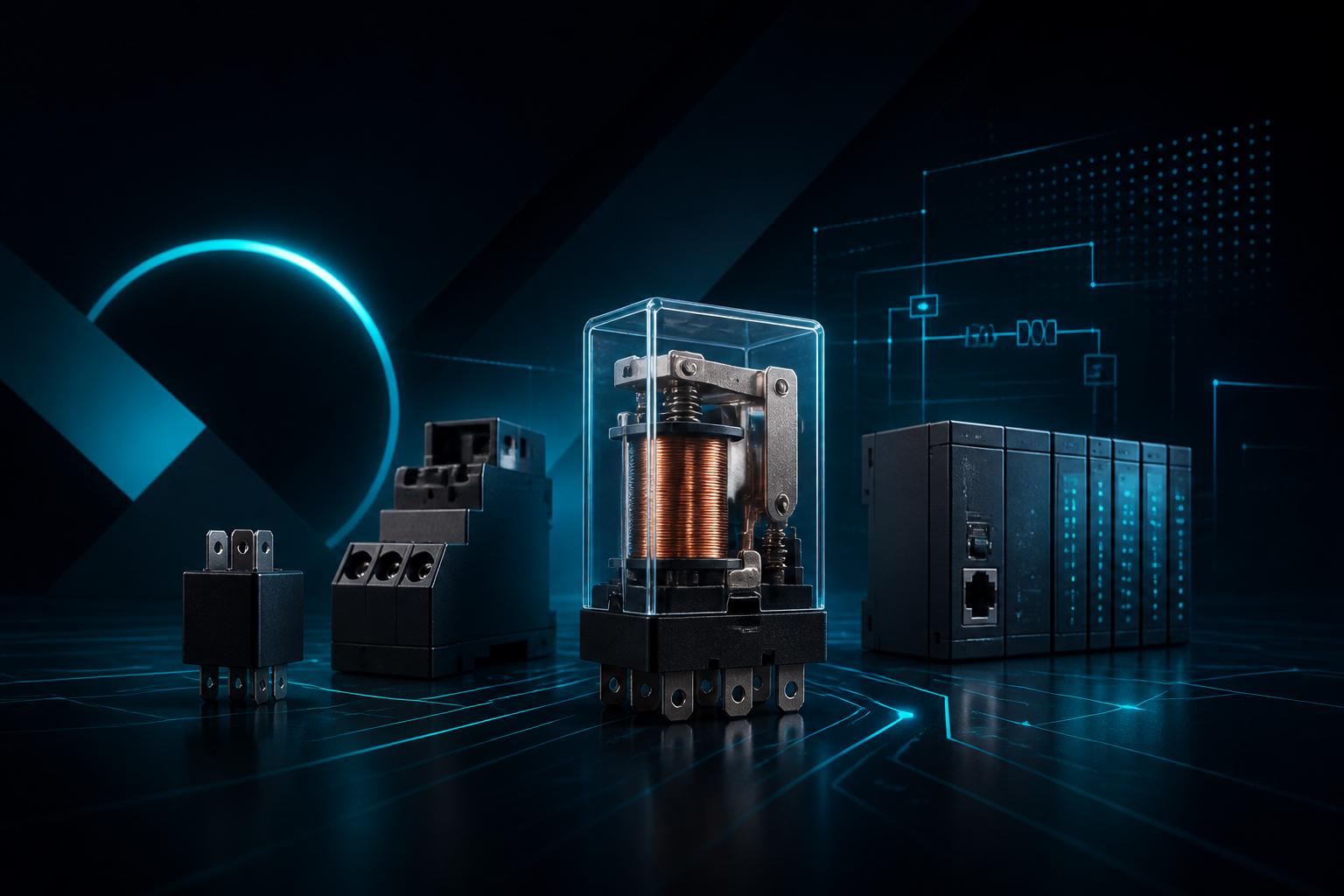
- The Coil: This is the input side. When a small voltage is applied, it produces an electromagnetic field.
- The Armature: A moving component that responds to the coil's magnetic field to open or close contacts.
- Normally Open (NO): The circuit remains off until the relay receives a control signal.
- Normally Closed (NC): The circuit remains on until the relay receives a signal to break the connection.
Specifications and performance metrics
Choosing the right relay requires a comparison of speed, durability, and cost. Use the table below to evaluate the two primary technologies found in modern facilities.
| Performance Metric | Electromechanical Relay (EMR) | Solid State Relay (SSR) |
|---|---|---|
| Switching Speed | Milliseconds (Slower) | Microseconds (Very Fast) |
| Moving Parts | Mechanical Armature | None (Semiconductor) |
| Typical Lifespan | 10^5 to 10^6 Cycles | Estimated 10^9 Cycles |
| Acoustic Profile | Audible "Click" | Silent Operation |
| Optimal Use Case | General Power Switching | High-Frequency Pulse Width Modulation |
What are the main types of relay in industrial automation?
Electromechanical Relays (EMR)
Electromechanical relays are the traditional workhorses of the industrial world. They use a physical coil to move a metal arm that connects or disconnects the contacts. I often prefer these for small businesses because they are incredibly easy to troubleshoot. If a technician is on a loud shop floor, they can often hear the relay click or see the physical movement of the armature. This immediate feedback helps isolate whether a problem lies in the software logic or the physical hardware. They are robust and handle power surges better than their solid-state counterparts.
Solid State Relays (SSR)
Solid state relays utilize semiconductors like thyristors or transistors to perform the switching. Since they have no moving parts, they do not suffer from mechanical wear and tear. This makes them the primary choice for applications requiring rapid switching, such as precision temperature control in food processing or chemical manufacturing. Furthermore, because they do not create a physical spark when switching, they are safer in environments where volatile gases or dust might be present. However, they do require heat sinks to manage the thermal energy generated by their internal resistance.
Control Relays vs. Protection Relays
It is vital to distinguish between general switching components and specialized protection hardware. Most businesses use control relays to manage machine logic and basic operations. In contrast, protection relays are complex intelligent electronic devices designed to detect dangerous faults like short circuits on utility grids. While protection relays are critical for high-voltage infrastructure, your focus for facility automation will almost always be on reliable, high-quality control relays that interface with your AI agents and PLC systems.
Why should you prioritize a relay in industrial automation?
Enhancing system safety and component longevity
Directly connecting a digital controller to a heavy motor is a design flaw that leads to frequent downtime. When a motor turns off, it can release a massive spike of stored energy back into the circuit. By placing a relay in industrial automation between the controller and the load, you sacrifice a cheap, replaceable component to protect a multi-thousand-dollar control computer. This modularity means that if a relay wears out due to heavy use, a maintenance worker can swap it in minutes without needing to reprogram the whole system.
Bridging the gap between software and hardware
In a modern automated environment, software is the brain, but the relay is the muscle. Suppose an AI-driven security bot decides to lock a specific zone in your warehouse. The software identifies the need and sends a low-voltage signal to a network-connected controller. That controller then energizes a relay, which physically interrupts the power to a magnetic lock. Without the relay, the software "decision" remains trapped in the digital realm, unable to impact the physical world.
Scaling electrical outputs for complex workflows
Quite often, one control signal needs to trigger multiple actions. A single "Emergency Stop" event might require turning off three separate conveyors, activating a siren, and flashing a warning light. Multi-pole relays allow one small input to control several independent high-power circuits simultaneously. This simplifies your wiring architecture and ensures that synchronized actions happen exactly at the same moment, which is critical for safety and process efficiency.
What are common business applications for a relay in industrial automation?
Assembly and packaging lines
On a modern conveyor line, photo-eye sensors detect when a product reaches a specific point. This sensor signal, usually 24V DC, triggers a relay that starts a sorting motor or opens a pneumatic solenoid. This application of a relay in industrial automation ensures that heavy physical work follows the precise timing dictated by electronic logic. Many facilities use these setups to reduce manual repetitive labor and increase throughput in fulfillment centers.
HVAC and environmental management
Maintaining specific temperature and humidity levels in a brewery, lab, or server room is a 24/7 task. A digital thermostat provides a low-power signal when environmental thresholds are crossed. This signal energizes a high-capacity relay, which then engages the industrial-grade compressors or fans. Using relays in this manner allows the high-voltage power lines to remain in the machinery room while the delicate control interfaces are placed conveniently at the user's eye level.
Physical access control and facility security
Biometric scanners and RFID readers are low-power devices. When a customer or staff member presents a valid credential, the reader pulses a signal to a relay. The relay then switches the 12V or 24V power required to release an electromagnetic door strike. This fundamental architecture is used in virtually every commercial building to manage foot traffic and secure sensitive areas while keeping the electronics isolated from the heavy-duty power required for physical locking mechanisms.
How do you select and install a relay in industrial automation?
Matching the hardware to the load character
A frequent error in facility maintenance is ignoring the difference between resistive and inductive loads. Devices like motors and solenoids create high in-rush currents. According to electrical standards outlined by organizations like Wikipedia, you should often derate a relay's capacity by up to 70% or 80% when switching inductive loads compared to simple heaters. Always verify the "Horsepower" or "Inductive" rating on the relay casing rather than just the simplified Amperage rating.
Choosing the correct coil voltage
The relay coil must be compatible with your controller's output pins. Standard industrial control voltages include 5V DC for hobbyist microcontrollers, 24V DC for industrial PLCs, and 120V AC for older building automation systems. If you apply 24V to a 5V coil, you will destroy the relay instantly. If you are uncertain how to map your digital outputs to physical hardware, consulting with professional AI consultancy services can help ensure your hardware layer matches your software logic.
Installation workflow and best practices
- De-energize the entire system: Ensure both the control power and the high-voltage load power are fully disconnected before touching any terminals.
- Verify the pinout diagram: Relay manufacturers use different pin configurations. Never assume a new relay matches the old one just because the shape is similar.
- Utilize DIN Rail mounting: In a professional environment, relays should be mounted on standardized DIN rails inside a NEMA-rated enclosure to protect them from vibration, dust, and moisture.
- Label every wire: Clearly marking the "Coil" and "Contact" wires is essential. This saves hours of troubleshooting when a component eventually needs replacement.
- Conduct a dry run: Test the control signal and listen for the relay to switch (the click) before applying power to the heavy machine on the load side.
What is the future of relays in the age of AI?
As we transition toward autonomous factory floors, the relay in industrial automation remains the indispensable final link. We are seeing a rise in "Smart Relays" or Programmable Relay Modules that contain internal logic and network connectivity. However, the requirement for physical, galvanic isolation will never disappear. While software grows more intelligent and AI prompts help us write better control code, electricity will always follow the laws of physics. Understanding the bridge between the two is how businesses achieve true operational efficiency.
Frequently asked questions
Is a relay the same as an industrial contactor?
They are similar in function but different in scale. A relay is designed for lower current logic switching or small loads. A contactor is a heavy-duty variant designed specifically for large electric motors and high-wattage lighting systems, often featuring specialized arc suppression to prevent fire hazards during switching.
When should I choose an SSR over a mechanical relay?
You should choose a Solid State Relay (SSR) when your application requires switching hundreds of times per hour, such as a heater maintaining a tight temperature tolerance. However, avoid SSRs if you need a guaranteed "air gap" for safety isolation or if you are working in an environment with frequent high-voltage spikes, as semiconductors are more fragile than physical metal contacts.
Why does my relay click continuously without starting the load?
This "chattering" usually suggests that the control voltage is dropping as soon as the relay tries to engage, or there is a wiring fault on the load side. If the relay clicks but the machine stays off, check for a blown fuse in the high-power circuit or burnt-out contacts inside the relay housing caused by an electrical overload.
How can AI help me manage my industrial relays?
AI can be used for predictive maintenance by monitoring the number of relay cycles and alerting your team before a component reaches its end-of-life rating. Additionally, those new to AI can use generative models to write the ladder logic or Python code required to sequence relay banks in complex automation workflows.