
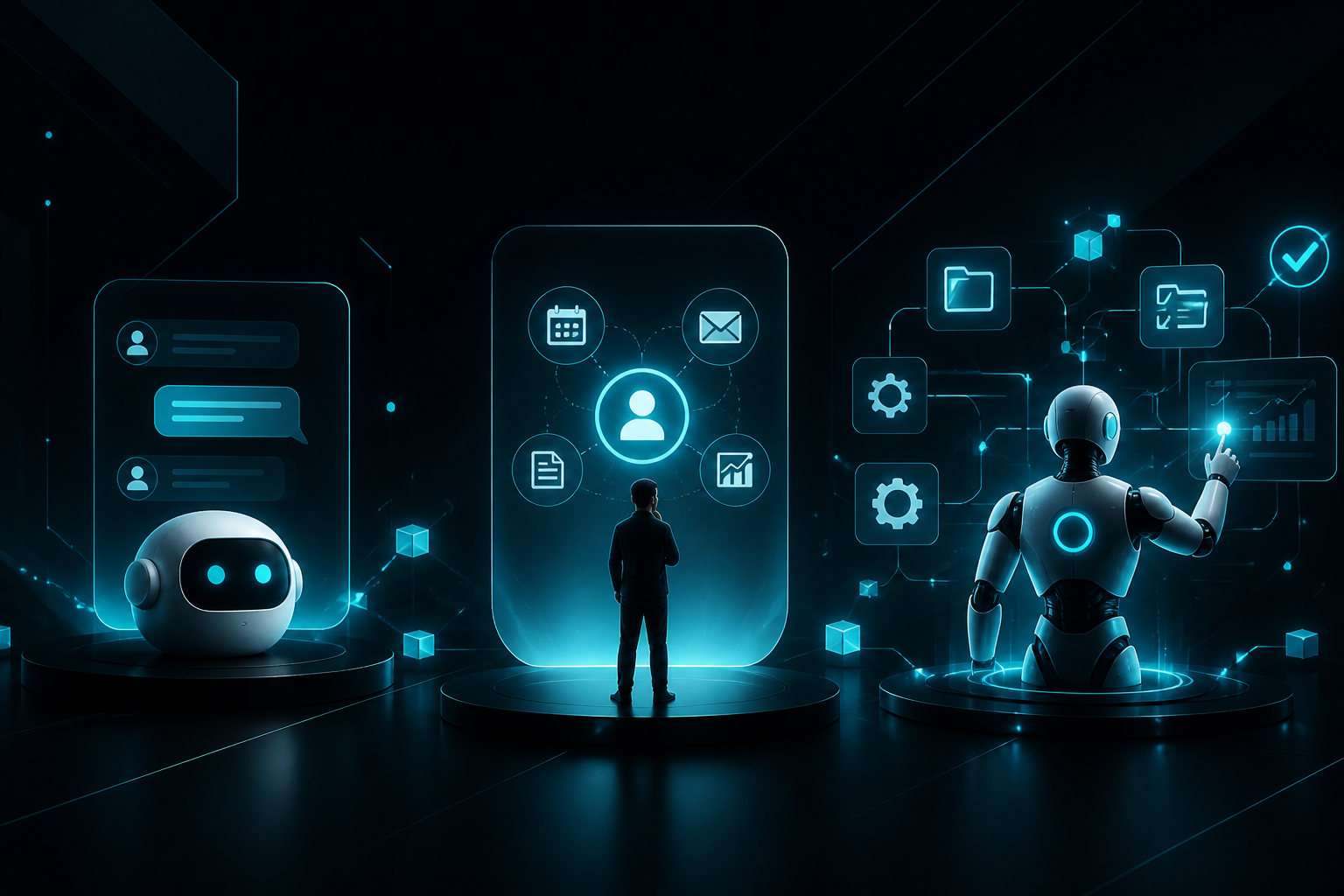
AI Agent vs AI Assistant vs Chatbot: What Actually Matters

Ask ten people to define "AI agent," "AI assistant," and "chatbot" and you'll get ten answers, partly because vendors slap whichever label sells better on the same underlying model. The distinction that actually matters for your business is autonomy: how much the tool does on its own after you hand it a job. Here's how the three differ, when each one earns its keep, and how to pick without overpaying for capability you won't use.
Key takeaways
The real dividing line is autonomy. A chatbot follows a script, an assistant completes the single task you ask and stops, and an agent takes a goal and runs the multi-step work until it's done or hits a guardrail.
Assistants help you think; agents help you act. ChatGPT and Claude are assistants by default; they become agent-like only when you give them tools, memory, and a reasoning loop.
Starting a new project on a rule-based chatbot is hard to justify now. Anything a scripted bot handles (FAQs, lookups, form-filling), an agent also handles, plus the long tail of requests scripts break on.
Gartner predicts that by 2028, at least 15% of day-to-day work decisions will be made autonomously by AI agents, up from near zero today.
What's the difference between an AI agent, an AI assistant, and a chatbot?
The difference is how much the system does after you give it input. A chatbot reacts to a prompt with a scripted or single-shot reply. An AI assistant completes the specific task you request, returns the output, and waits for your next instruction. An AI agent takes an objective, plans the steps, uses tools to carry them out, and keeps going until the goal is met or it reaches a boundary it can't cross alone.
The categories overlap in practice, and the industry has not settled on fixed definitions. As Grammarly's 2026 explainer puts it, assistants and agents often run on the same underlying technology yet solve different problems. Aisera frames the split cleanly: assistants are request-driven and help you think, while agents are goal-driven and help you act.
Chatbot | AI assistant | AI agent | |
|---|---|---|---|
Trigger | User prompt | User request | A goal you assign |
How it works | Follows rules or scripts | Completes one task, then stops | Plans and executes multiple steps |
Autonomy | None; reactive | Low; needs your input each step | High; works within guardrails |
Uses external tools | Rarely | Sometimes | Yes, by design |
Best at | FAQs, simple lookups | Drafting, summarizing, answering | Multi-step workflows start to finish |
Example | Website support widget | ChatGPT, Claude | A lead research agent that builds a prospect list on its own |
What is a chatbot, and is it still worth using?
A chatbot is a rule-based, reactive tool that follows scripts and responds to prompts. It's read-only in the sense that matters: it answers, but it doesn't reason across steps or take action in your other systems. The support widget that offers you three canned buttons and a "talk to a human" link is the classic example.
Chatbots still have a place for narrow, high-volume, predictable questions where a wrong answer is cheap and the script rarely breaks. But starting a new project on a pure rule-based chatbot in 2026 is hard to justify. As multiple current sources note, an AI agent handles everything a chatbot can (FAQs, simple lookups, data collection) while also handling the long tail of requests a script was never written for. Cognigy and others describe the practical result: the chatbot dead-ends on anything off-script, and the customer ends up frustrated.
If you already run a scripted bot and it works, there's no urgency to rip it out. When you rebuild, though, the smarter default is a more capable system underneath.
What is an AI assistant, and what are ChatGPT and Claude?
An AI assistant is request-driven software that completes the task you ask, returns the result, and stops. You prompt it, it responds, and it waits for your next move. ChatGPT and Claude, used in their standard chat form, are assistants: you ask for a summary, a draft email, or an explanation, and you get one back.
Assistants are built for day-to-day productivity. They're excellent at helping you think, write, and decide faster. What they don't do on their own is chain a sequence of actions across your tools without you steering each step. GWI's April 2025 piece makes the same point: assistants require constant user input to function.
This is where most small businesses actually live right now, and it's a fine place to be. A well-prompted assistant covers a huge amount of ground. The limit shows up when the job has ten steps and you're the one clicking through all ten. That's the signal you've outgrown an assistant for that particular task.
What is an AI agent, and how is it different from an assistant?
An AI agent is goal-driven software that plans the steps to reach an objective, executes them using available tools, and only stops when the work is done or it hits a limit it can't resolve. Give it a goal instead of a single instruction, and it figures out the sequence itself.
The difference from an assistant is degree of autonomy. Autonomous's March 2026 comparison sums the shift as read-only versus read-write-and-act: an assistant answers, an agent reads, writes, and takes action across systems within the guardrails you set. An LLM without a reasoning loop processes one request at a time; an agent chains observations and actions to solve a compound problem.
A concrete example from our own library: a proposal builder agent doesn't just draft a paragraph when asked. Point it at a client brief and it pulls the relevant service details, structures the sections, prices the scope, and returns a near-finished document. Same with an AEO audit agent that crawls a page, checks it against answer-engine criteria, and hands back a prioritized fix list rather than waiting for you to ask about each element one at a time.
The line between an advanced assistant and a simple agent is not sharp. It's about how many steps the tool takes on your behalf before it needs you again.
How do I choose between an agent, an assistant, and a chatbot?
Match the tool to the shape of the job, not to the label. Use this test:
One predictable question, asked constantly? A chatbot or an assistant handles it. Don't build an agent for "what are your hours."
A task where you want to stay in control of each step? An assistant. Drafting, brainstorming, summarizing, and one-off research are assistant work. ChatGPT and Claude do this well.
A repeatable workflow with several steps that you keep doing by hand? An agent. If you find yourself running the same five-click sequence every week, that's the job to hand off.
The cost trade-off is real. Agents take more setup and guardrails than firing a prompt into an assistant, and they can act on the wrong thing at scale if you skip the guardrails. Assistants are cheaper to start and safer because you approve each output. The payoff of an agent is time back on work you'd otherwise repeat forever.
At SynaBot we curate all three types so you're not guessing which underlying tech you're buying. Our Pro Tier gives access to the full library of assistants, prompts, and agents, so you can start a task with an assistant and move it to an agent when the workflow proves itself. . Most people don't need to pick a side; they need the right one for each task, and the ability to switch as the work grows.
Frequently asked questions
Is ChatGPT an AI agent or an AI assistant?
In its standard chat form, ChatGPT is an AI assistant: you ask, it answers, and it waits for your next request. It becomes agent-like only when you add tools, memory, and a reasoning loop that lets it plan and execute multiple steps toward a goal on its own. The same is true of Claude.
What is the main difference between an AI agent and an AI assistant?
Autonomy. An AI assistant is request-driven and completes the single task you ask before stopping, while an AI agent is goal-driven and carries out the multi-step work needed to reach an objective. As several 2025 and 2026 industry explainers put it, assistants help you think and agents help you act.
Are chatbots the same as AI agents?
No. A chatbot is a rule-based, reactive tool that follows scripts and answers one prompt at a time, while an AI agent can reason, adapt, and take independent action across steps and systems. An agent can do everything a chatbot does plus the requests a script can't handle.
Which is best for a small business?
It depends on the task. For quick drafting, research, and answers, an AI assistant like ChatGPT or Claude is enough. For repeatable multi-step workflows you keep doing by hand, an AI agent pays off. Many small businesses use both and switch based on the job rather than committing to one category.
Do AI agents replace AI assistants?
No. They solve different problems even though they often share the same underlying model. Assistants stay useful for on-demand help where you want control of each step, while agents take over defined, repeatable work. Gartner expects agents to make at least 15% of daily work decisions autonomously by 2028, which shifts the balance without erasing the assistant use case.